Maeve Cavaleri, a student of environmental science at the University of Massachusetts in Boston, chose the school because it was “the cheapest and closest option.”
Even though she receives in-state tuition and a discount since her father is a former employee of the university, Maeve worked full-time (before her hours got cut down to just 25 a week) on top of a full course load to pay for her education. She hopes that this bachelor’s degree will help provide her with a stable source of income and job security after graduation, “but,” she said, “working full-time was so hard because all I thought about was work and all the school work I had to do.”
Despite eliminating the cost of community college for all non-degree holders in 2024 through MassEducate, Massachusetts has yet to address the rising cost of other four-year institutions in such a blanket manner.
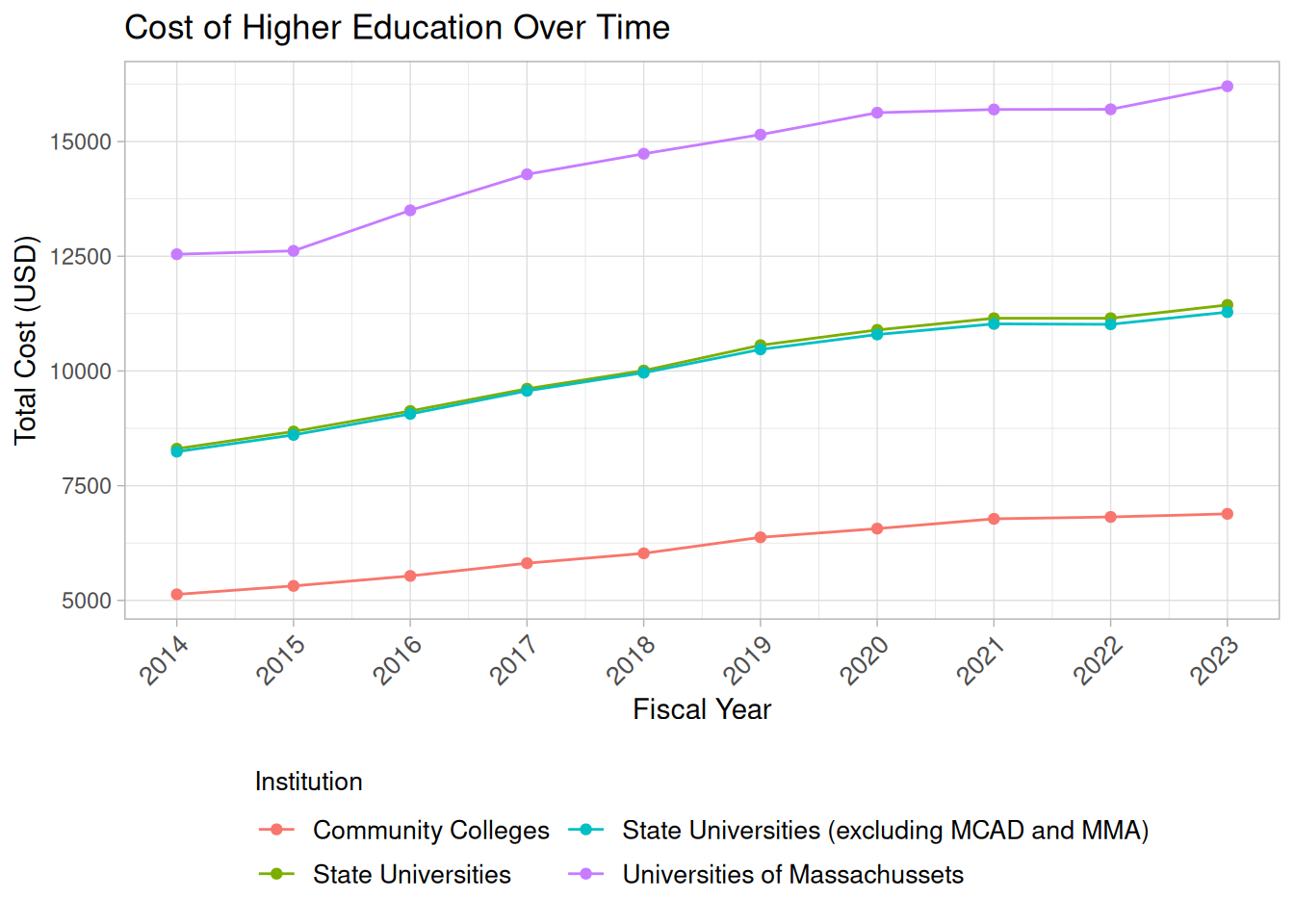
From 2014 to 2023, the annual price of tuition and mandatory fees at Massachusetts State Universities, Universities of Massachusetts (UMass), and community colleges grew by approximately 30% across the board, according to data published by the MA Department of Higher Education.
The dataset divides institutions of higher education into three categories: Universities of Massachusetts (the UMass system), state universities, and community colleges. The UMass system and state universities are different due to their missions, as defined by the MA Dept. of Higher Education. While UMass schools offer students research opportunities and a wide program of study, each state university provides academics geared to build on their local community’s strengths, resources and needs.
State universities are further separated into “comprehensive” and “specialized” schools. Comprehensive state universities – which are the majority – integrate liberal arts, sciences, and professional education programs. Specialized state universities focus on specific academic areas of study, such as the Massachusetts College for Art and Design (MCAD) and the Massachusetts Maritime Academy (MMA). On average, state universities cost a little over $11,000 for an entire academic year in 2023.
The University of Massachusetts system is the most expensive option with a price tag of over $15,000 on average. These thousands of dollars don’t include the cost of housing, meal plans, or on-campus parking, which pose additional financial challenges for students. Additional costs that students like Maeve are willing to pay.
For Maeve, who planned her classes to only be on two days of the week to cut down on parking costs and makes the 40-minute commute to school, the allure and promise of a four-year degree overshadowed free community college.
She attended a community college for the spring semester of 2024, right before MassEducate expanded free tuition to non-degree holders of all ages. She then decided to transfer to UMass Boston and with her discount, the annual tuition and mandatory fees at UMass Boston were the same as at the community college.
MassReconnect and MassEducate eliminated the cost of community college in 2024, but students such as Maeve continue to pay out of pocket with money earned from grueling hours to go to a four-year institution instead. The data shows that the costs are rising for public universities in Massachusetts at a rate of 3% per year, but Maeve’s experience demonstrates that students will bear the price regardless of the cost.
Data obtained from “Public Postsecondary Tuition and Fees,” published on February 7, 2025.